
Curriculum Framework for Children & Young People with Vision Impairment
At Joseph Clarke School, we are committed to providing a broad, balanced and ambitious curriculum that enables every pupil to achieve their potential, develop independence and prepare for life beyond school.
The Curriculum Framework for Children and Young People with Vision Impairment (CFVI) is central to our curriculum design and delivery. It provides a specialist framework that helps us identify and address the additional learning needs of children and young people with vision impairment, ensuring that they develop the knowledge, understanding and skills needed to access education, participate fully in everyday life and become increasingly independent.
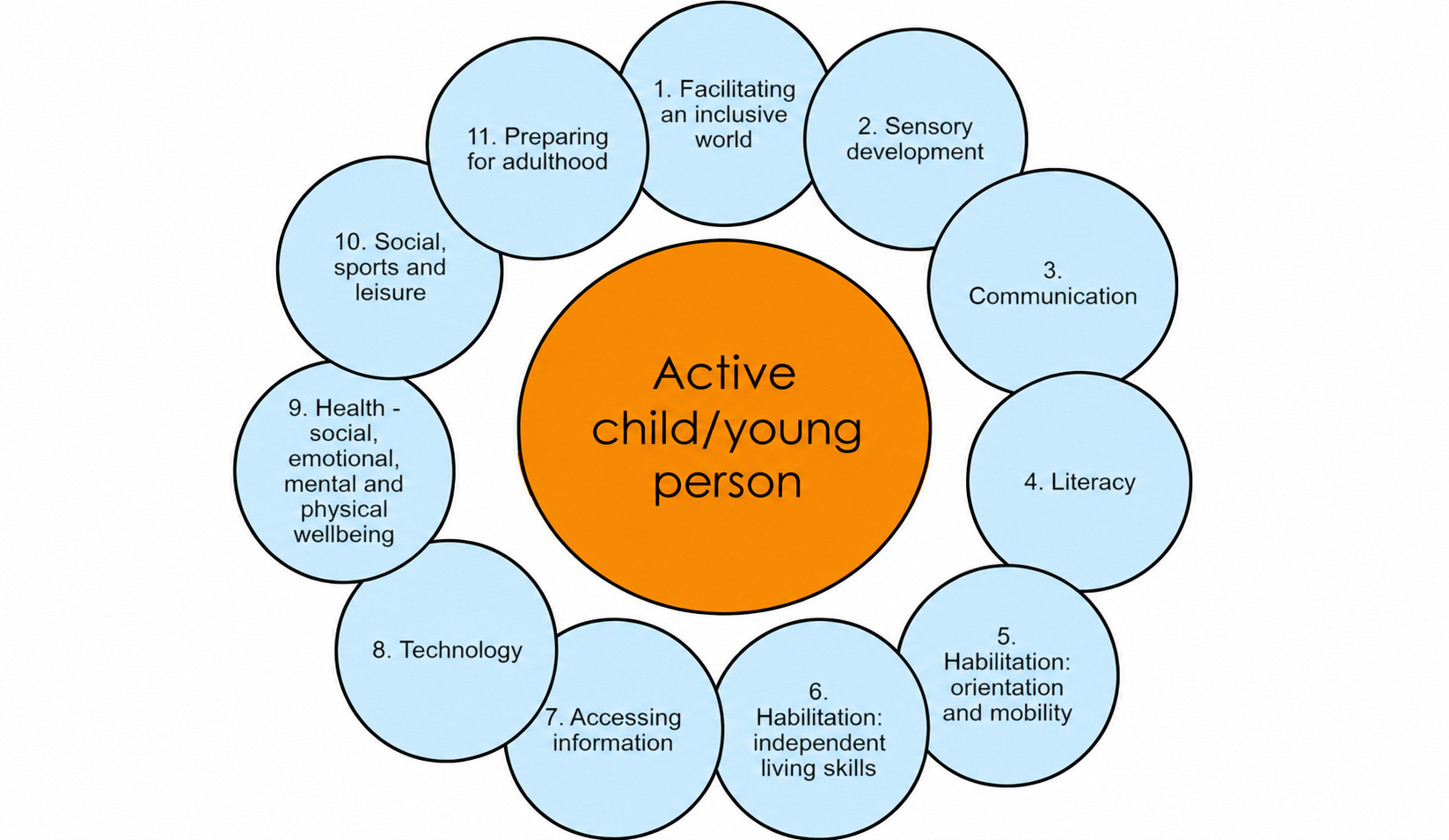 The CFVI recognises that children and young people with vision impairment may experience barriers to learning and may not have the same opportunities for incidental learning as their sighted peers. Consequently, some skills need to be taught explicitly, systematically and in meaningful contexts.
At Joseph Clarke School, the CFVI complements our wider school curriculum and is embedded within our teaching, learning and specialist provision.
The 11 Areas of the CFVI
The CFVI consists of 11 interconnected areas that support the holistic development of children and young people with vision impairment:
- Facilitating an Inclusive World
- Sensory Development
- Communication
- Literacy
- Habilitation: Orientation and Mobility
- Habilitation: Independent Living Skills
- Accessing Information
- Technology
- Health: Social, Emotional, Mental and Physical Wellbeing
- Social, Sports and Leisure
- Preparing for Adulthood
These areas work together to support pupils’ access to learning, communication, independence, wellbeing and participation in the wider community. The framework places the child or young person at its centre, recognising their individual strengths, needs, aspirations and preferred ways of learning.
How the CFVI Informs Our Curriculum (Click to Expand)
At Joseph Clarke School, the CFVI is not viewed as an additional or standalone curriculum. Instead, it is woven throughout our curriculum planning, subject teaching, learning experiences and specialist interventions.
Teachers consider relevant CFVI areas when designing and delivering lessons, ensuring that pupils have opportunities to develop specialist skills alongside their subject knowledge and understanding. For example:
- English and Literacy: Developing accessible reading and writing skills, including print, braille, tactile literacy, assistive technology and alternative recording methods.
- Mathematics: Developing mathematical understanding through tactile resources, accessible representations, practical experiences and appropriate technology.
- Science: Supporting sensory exploration, practical investigation, concept development and access to scientific information through adapted resources and meaningful experiences.
- Digital Skills: Developing digital literacy and independence through accessible technology, including screen readers, magnification, keyboard skills and other assistive tools.
- Physical Education: Developing spatial awareness, orientation, movement, physical confidence and participation in sports and physical activities.
- PSHE: Promoting emotional wellbeing, self-advocacy, social communication, relationships, independence and preparation for adulthood.
- Humanities and Wider Curriculum Subjects: Developing understanding of the world through accessible maps, tactile diagrams, real objects, descriptive language, experiential learning and opportunities to explore different environments.
Through this integrated approach, pupils develop both subject-specific knowledge and the specialist skills required to access and apply their learning with increasing confidence and independence.
Personalised CFVI Targets and Planned Interventions
Alongside the integration of CFVI within everyday teaching, pupils benefit from personalised CFVI targets and planned specialist interventions.
Targets are identified through ongoing assessment, observations, pupil progress and individual needs. They are closely linked to pupils’ Education, Health and Care Plan (EHCP) outcomes and their wider educational and developmental priorities.
Our formal curriculum approach also includes dedicated weekly intervention times, allowing pupils to receive focused teaching in areas that are particularly important for their development. Interventions may focus on:
- Orientation, mobility and independent living skills
- Communication and social interaction
- Literacy and accessible reading and writing
- Assistive technology and accessing information
- Sensory development and concept formation
- Emotional wellbeing, confidence and self-advocacy
- Independence and preparation for adulthood
Importantly, these skills are not taught only during intervention sessions. They are reinforced and applied throughout the school day, across different subjects, activities and environments, helping pupils transfer their learning into meaningful, everyday situations.
A Collaborative, Multidisciplinary Approach (Click to Expand)
Effective CFVI provision relies on partnership working. At Joseph Clarke School, the identification, setting and review of CFVI targets is a collaborative process involving a range of professionals, pupils and their families. Depending on individual needs, this may include:
- Qualified Teachers of Children and Young People with Vision Impairment (QTVIs), who provide specialist assessment, advice and guidance on vision impairment, accessibility and learning.
- Speech and Language Therapists (SaLT), who support the development of communication, language and interaction skills.
- Habilitation Specialists, who support orientation, mobility, independent living skills and safe, confident navigation of different environments.
- Assistive Technology Leads, who support pupils in developing the skills to use accessible technology effectively and independently.
- Class Teachers and Support Staff, who embed CFVI targets into curriculum planning, teaching and everyday learning opportunities.
- Parents and Carers, who contribute valuable knowledge of their child’s strengths, needs, experiences and priorities, supporting consistency between school and home.
- Pupils themselves, whose views, interests, aspirations and choices are central to identifying meaningful and relevant learning goals.
This collaborative approach ensures that CFVI targets are purposeful, personalised and responsive to each pupil’s changing needs.
Assessment, Progress and Review (Click to Expand)
We recognise that progress looks different for every pupil. Our approach to CFVI assessment therefore focuses on individual starting points, meaningful achievements and the development of skills over time.
Assessment information is used to inform future curriculum planning, adapt specialist provision and support discussions with pupils, families and professionals.
We place particular importance on pupils being able to apply and generalise their skills across different contexts, demonstrating increasing confidence, participation and independence.
Preparing Pupils for Life Beyond School (Click to Expand)
A key principle of the CFVI is that education should prepare children and young people not only to succeed in school, but also to participate fully in life beyond the classroom.
Throughout their time at Joseph Clarke School, pupils are supported to develop the skills they need to make choices, express their views, build relationships, access their communities and become as independent as possible.
By embedding the CFVI across our curriculum and specialist provision, we aim to equip every pupil with the knowledge, skills and confidence to thrive academically, socially and emotionally.
Our ambition is for every pupil to become a confident, empowered and active participant in their own learning and future.
Find Out More
Further information about the Curriculum Framework for Children and Young People with Vision Impairment can be found on the Royal National Institute of Blind People (RNIB) website: www.rnib.org.uk/cfvi